
The benefits of testosterone for women, according to 1,220 patients

In September 2026, the FDA held its first-ever public workshop on testosterone use in menopausal women. The questions on the table: What can testosterone actually do for women? How can they use it safely? And what will it take to develop standardized treatments designed for their bodies?
Testosterone is not currently FDA-approved for women, although doctors increasingly prescribe it off-label, with prescriptions to women nearly tripling from 2016 to 2025.
FDA workshop experts agreed that the evidence for testosterone in women is strongest for treating low sexual desire, known as hypoactive sexual desire disorder, or HSDD. Benefits for energy, mood, memory, and muscle, they said, need more study.
But in an analysis of more than 1,220 women in perimenopause or menopause from physician-led longevity platform Hone Health, women who took testosterone reported meaningful improvements across 18 menopause symptoms, with the biggest gains in sexual desire, energy, strength, and stamina.
What Women on Testosterone Reported
In September 2026, Hone analyzed menopause symptom improvement in 1,220 women taking testosterone but not estrogen or progesterone menopause hormone therapy. Symptoms were ranked using a standard questionnaire that healthcare providers use to track how menopause affects daily life.
The biggest improvements for women taking testosterone fell into three categories: sexual health, energy and stamina, and physical improvements such as muscle mass.
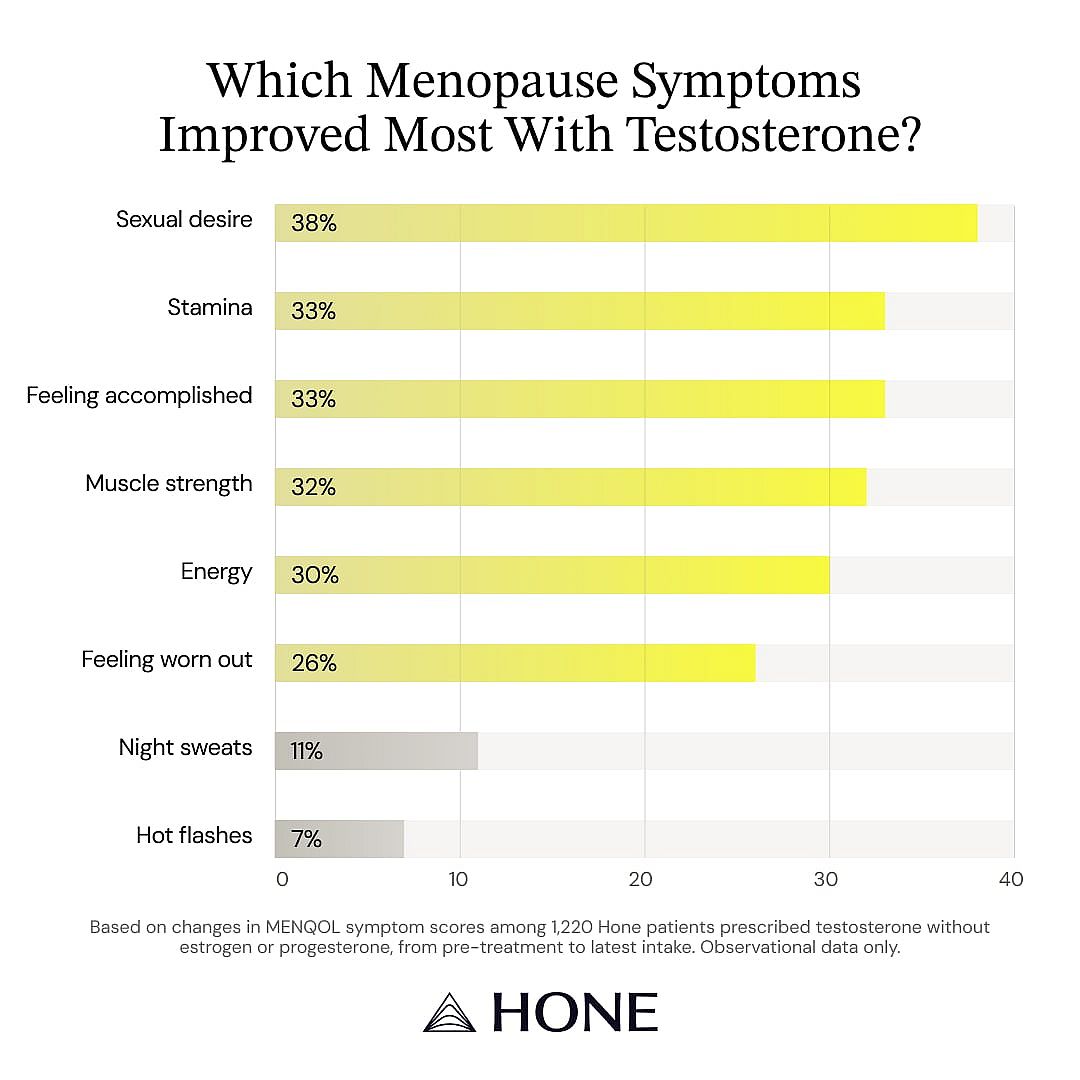
These improvements suggest that testosterone drives gains in energy, desire, and vitality in menopausal women.
"Much of this doesn't surprise me because it lines up with what we know testosterone is doing in the body," says Dr. Natalie Kunsman, MD, a Hone-affiliated family doctor who specializes in hormone health and regenerative medicine. “Tracking specific symptoms is like looking through a keyhole when we know testosterone is working the whole room."
Testosterone Benefits For Women, According to Their Doctors
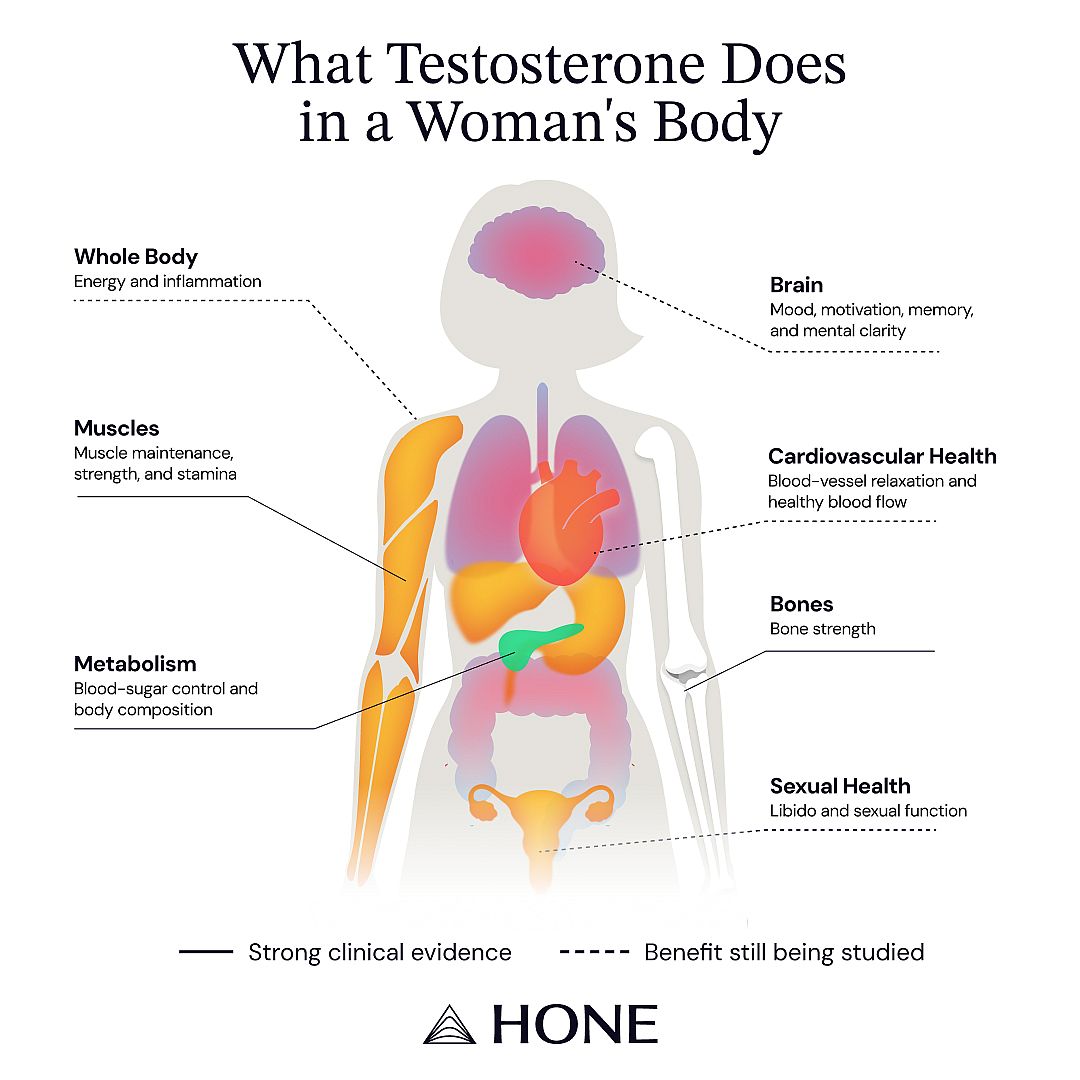
Doctors affiliated with Hone Health say testosterone’s benefits can extend well beyond sexual health. That makes sense given that testosterone receptors sit across multiple systems in the female body: throughout the brain, muscles, bones, and cardiovascular system. Women’s testosterone levels gradually decline with age, although the drop isn’t as closely tied to menopause as the declines in estrogen and progesterone.
Kunsman emphasizes that testosterone’s benefits for women don't always show up in symptom scores, but research increasingly backs them:
- Lean muscle mass. As women age, they lose lean mass, which raises the risk of frailty and worsens metabolic health. It's the same process that causes muscle wasting, or sarcopenia. "Without testosterone optimization, we have difficulty holding on to our lean mass," Kunsman says.
- Metabolic health. Muscle helps the body regulate weight and blood sugar, and low testosterone is linked to more body fat after menopause. Women in menopause who take GLP-1 agonists for weight loss may lose even more muscle, Kunsman says, since those drugs can strip muscle along with fat. She checks that women have optimal hormone levels before GLP-1 treatment to help protect against muscle loss.
- Bone density. Testosterone supports bone density, which declines in women through menopause. Low testosterone levels in women have been linked to osteoporosis. Testosterone spurs bone formation directly and also converts into estradiol, the estrogen that slows bone loss and reduces fracture risk.
- The brain. Testosterone plays a role in neuroplasticity, dopamine, and drive. In a 2025 pilot study of women already on hormone therapy, 47% reported better mood and 39% sharper thinking after four months on testosterone.
- Heart health. Testosterone may support blood vessel function in women and lower their blood pressure.
- Inflammation. Testosterone helps regulate immune function and can lower chronic low-grade inflammation, partly by reducing the excess body fat that fuels it.
Kunsman believes testosterone should be part of the HRT conversation alongside estrogen and progesterone. "Just because we don't have testicles doesn't mean we don't need testosterone," she says. The aim is physiological dosing that restores a woman to a range that’s optimal for her age and life stage.
Questions to Ask Your Doctor About Testosterone
If you're dealing with low sexual desire, low energy, loss of strength, or weight gain, especially in perimenopause or postmenopause, talk to your doctor about your symptoms. These questions can help guide the conversation:
- Am I a candidate for low-dose testosterone?
- Do I need a blood test to confirm low testosterone?
- Are you willing to prescribe low-dose testosterone, with or without blood testing?
- What form of testosterone would you prescribe, and why? (Cream, patch, and injection all avoid the cholesterol problems the FDA flagged with oral testosterone.)
- What do you consider an optimal testosterone range for a woman my age?
- How will we monitor my levels and adjust the dose over time?
- Are there safety considerations I should know about based on my health history?
If your physician isn't open to prescribing testosterone within the normal female range, telehealth companies offer physician-guided testosterone therapy for women as part of a hormonal assessment that includes lab work and regular follow-up appointments.
Methodology
Results come from Hone Health patient data in the Women's Optimization category, as of September 2026. Symptom outcomes were measured using the Menopause Quality of Life Questionnaire (MENQOL), a validated clinical tool that scores symptoms from 0 to 6, where lower scores mean fewer or less bothersome symptoms. In men, physicians use the qADAM questionnaire to assess testosterone deficiency, but there is no equivalent for women.
The analysis compared each patient's first and most recent MENQOL assessment. Women with fewer than two assessments were excluded. The test group included 1,220 patients who had a testosterone prescription and no recorded estradiol, estrogen, or progesterone prescription through Hone.
These are observational findings with no randomized control group, so they show association, not proof of cause and effect. Prescription records reflect Hone history only. Some patients may have received hormones from other providers not captured in this data.
This story was produced by Hone Health and reviewed and distributed by Stacker.


Comments